

 Image 1 of 1
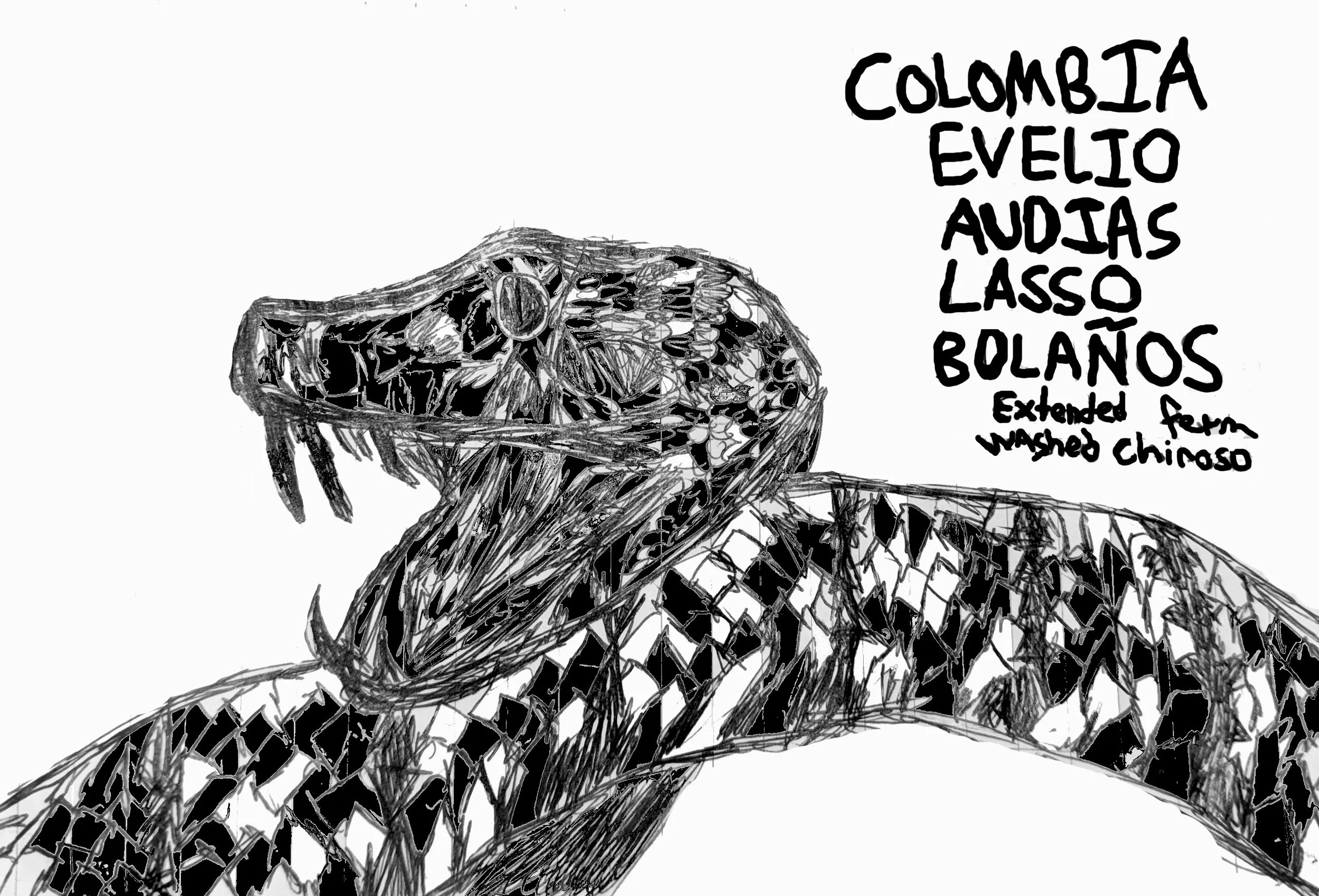
Colombia - Evelio Audias Lasso Bolaños (Extended Fermentation Washed Chiroso) (Blood Orange, Guava Paste, Tropical Fruits, Grape)
From the supplier:
Evelio Lasso manages a 3.5-hectare farm at a staggeringly high altitude in northern Nariño, one of Colombia’s most remote and dramatically mountainous departments. Aside from an extended parchment fermentation, this microlot is a low-intervention fully washed coffee. That means all the delicate honeycomb and vanilla-like esters, the intense clarity of the acids, the creamy cup structure, and the bright flavors—apricot, pineapple, tomato—are coming right from the coffee seed itself.
Chiroso translates to something like “tattered” or “shabby” in Colombian Spanish. The unique phenotype, with a slightly elongated fruit shape and a scrappy, unkempt-like plant structure, was first spoz as tted in the Antioquia department and originally believed to be a kind of Caturra—thus the name. RD2 Vision, a bio-research project that maps the genetic fingerprints of many of the world’s arabicas, has linked the “Chiroso” genotype directly to an Ethiopian landrace, with no other crossings. If true, this would be a far cry from Caturra lineage, since Caturra itself is part of the bourbon group.
Alas, another delicious coffee, another hazy genealogy. Some cuppers and Colombian coffee roasters have started referring to the plant as “Colombian Gesha”, given its direct link to Ethiopian genetics. And why not! What matters is that Evelio and his good friend Nature produced this, and we are loving it.
Northern Nariño & Terra Coffee SAS
The municipality of San Pedro de Cartago is just south of La Unión, a very well-known part of Nariño for its big-bodied and sweet coffees. The border with the Cauca department isn’t more than a few kilometers north, but here in Colombia’s southern Andes the landscape seems to explode outward in scale compared to the tightly-wound slopes of Huila or the plateaus of Cauca. Northeastern Nariño is uniformly high altitude, dense, and rugged, with elevations surpassing 2400 meters. From La Union south to the enormous Galeras volcano, whole cities are perched on narrow ridgelines and the valleys seem to have no bottom.
Terra Coffee SAS is a local producer group, established in 2016 by Weimar Lasso and Juliana Guevara. These are the same owners of the beloved La Terraza farm in Huila, from whom we buy a number of microlots every year. The small company manages one single producer association in each department where they work, “Ecoterra” in Nariño, with 140 producer partners, and “Terra Verde” in Huila, with 120.
For Terra Coffee SAS, quality is seen as a direct pathway to well-being for volume-limited, small coffee farming families. Driving their business model is an understanding that quality results from small harvests have direct impacts on not just the farm owner, but the many dependents on each small farm, including young children, older adults, and the women of the household performing essential labor that often goes unpaid. By increasing quality and placing microlots in the market, Terra Coffee SAS plans not only to increase prices to growers and their families, but also increase their sense of pride in the details of their work.
Microlots like Evelio’s are selected through the same R&D processes as Weimar and Juliana’s own coffees from La Terraza. In this particular case, Evelio himself has 18 years of cupping experience in renowned Colombian labs, so is no stranger to the process.
Processing
Chiroso cherry for this lot was picked by hand by Evelio’s annual pickers—personnel that stay with him from harvest to harvest and are well-calibrated with his high expectations. All pickings for this lot were depulped every harvest day in the evening, and left to ferment “dry” (without any water) for 50-60 hours. Such a long fermentation period is partly by design and partly by necessity, due to the cold alpine temperatures that greatly retard the process. Once fully broken down the mucilage was washed completely off the parchment with fresh water, and the parchment was moved to dry in two stages: first in a single layer for 36 hours until dry to the touch; then in a slightly higher pile in Evelio’s parabolic dryer, where the coffee is rotated regularly over the next 25-30 days.
Low, and slow: those of us present for earlier waves of microlot coffee when terroir, not processing, was the main differentiator, were taught over and over the positive potential of alpine climates on coffee quality. Slower cherry maturation, lower fermentation temperatures and longer drying times naturally occur in cold, challenging conditions, and naturally beget dense, bright, complex coffees. The study of these conditions over the past decade have led to some great alpine mimicry techniques in processing like thermal shock or cold storage, and in one producer’s case in Bolivia, transporting cherry to 3,000 meters to process it in the extremities of the altiplano. Farms like Evelio’s have become a kind of template of desirable processing environments which, although painstakingly slow (this microlot took 33 days on the farm to finish), are capable of the kind of washed coffees that we have marveled at for decades.
From the supplier:
Evelio Lasso manages a 3.5-hectare farm at a staggeringly high altitude in northern Nariño, one of Colombia’s most remote and dramatically mountainous departments. Aside from an extended parchment fermentation, this microlot is a low-intervention fully washed coffee. That means all the delicate honeycomb and vanilla-like esters, the intense clarity of the acids, the creamy cup structure, and the bright flavors—apricot, pineapple, tomato—are coming right from the coffee seed itself.
Chiroso translates to something like “tattered” or “shabby” in Colombian Spanish. The unique phenotype, with a slightly elongated fruit shape and a scrappy, unkempt-like plant structure, was first spoz as tted in the Antioquia department and originally believed to be a kind of Caturra—thus the name. RD2 Vision, a bio-research project that maps the genetic fingerprints of many of the world’s arabicas, has linked the “Chiroso” genotype directly to an Ethiopian landrace, with no other crossings. If true, this would be a far cry from Caturra lineage, since Caturra itself is part of the bourbon group.
Alas, another delicious coffee, another hazy genealogy. Some cuppers and Colombian coffee roasters have started referring to the plant as “Colombian Gesha”, given its direct link to Ethiopian genetics. And why not! What matters is that Evelio and his good friend Nature produced this, and we are loving it.
Northern Nariño & Terra Coffee SAS
The municipality of San Pedro de Cartago is just south of La Unión, a very well-known part of Nariño for its big-bodied and sweet coffees. The border with the Cauca department isn’t more than a few kilometers north, but here in Colombia’s southern Andes the landscape seems to explode outward in scale compared to the tightly-wound slopes of Huila or the plateaus of Cauca. Northeastern Nariño is uniformly high altitude, dense, and rugged, with elevations surpassing 2400 meters. From La Union south to the enormous Galeras volcano, whole cities are perched on narrow ridgelines and the valleys seem to have no bottom.
Terra Coffee SAS is a local producer group, established in 2016 by Weimar Lasso and Juliana Guevara. These are the same owners of the beloved La Terraza farm in Huila, from whom we buy a number of microlots every year. The small company manages one single producer association in each department where they work, “Ecoterra” in Nariño, with 140 producer partners, and “Terra Verde” in Huila, with 120.
For Terra Coffee SAS, quality is seen as a direct pathway to well-being for volume-limited, small coffee farming families. Driving their business model is an understanding that quality results from small harvests have direct impacts on not just the farm owner, but the many dependents on each small farm, including young children, older adults, and the women of the household performing essential labor that often goes unpaid. By increasing quality and placing microlots in the market, Terra Coffee SAS plans not only to increase prices to growers and their families, but also increase their sense of pride in the details of their work.
Microlots like Evelio’s are selected through the same R&D processes as Weimar and Juliana’s own coffees from La Terraza. In this particular case, Evelio himself has 18 years of cupping experience in renowned Colombian labs, so is no stranger to the process.
Processing
Chiroso cherry for this lot was picked by hand by Evelio’s annual pickers—personnel that stay with him from harvest to harvest and are well-calibrated with his high expectations. All pickings for this lot were depulped every harvest day in the evening, and left to ferment “dry” (without any water) for 50-60 hours. Such a long fermentation period is partly by design and partly by necessity, due to the cold alpine temperatures that greatly retard the process. Once fully broken down the mucilage was washed completely off the parchment with fresh water, and the parchment was moved to dry in two stages: first in a single layer for 36 hours until dry to the touch; then in a slightly higher pile in Evelio’s parabolic dryer, where the coffee is rotated regularly over the next 25-30 days.
Low, and slow: those of us present for earlier waves of microlot coffee when terroir, not processing, was the main differentiator, were taught over and over the positive potential of alpine climates on coffee quality. Slower cherry maturation, lower fermentation temperatures and longer drying times naturally occur in cold, challenging conditions, and naturally beget dense, bright, complex coffees. The study of these conditions over the past decade have led to some great alpine mimicry techniques in processing like thermal shock or cold storage, and in one producer’s case in Bolivia, transporting cherry to 3,000 meters to process it in the extremities of the altiplano. Farms like Evelio’s have become a kind of template of desirable processing environments which, although painstakingly slow (this microlot took 33 days on the farm to finish), are capable of the kind of washed coffees that we have marveled at for decades.